Popular ride hailing app Ola announced the launch of its Progressive Web app (PWA), a lightweight data-friendly mobile website, aimed at users in small towns and cities for an app-like experience on low-end smartphones. It was launched together with Google at Google's I/O 2017 event in San Francisco.
Ola PWA is similar to the native app in terms and looks and feel, but uses very less data. It can operate on 2G speeds, and users can make offline bookings via the website as well. It is said to load in just 3.4 seconds on 2G networks, and OLA claims that its PWA consumes 50kb data on first payload and 10kb on subsequent loads.
"Using just 200KB of data to install, the PWA is at least 300X smaller than downloading the Android app and 500X smaller than downloading their iOS app. Repeat visits use as little as 10KB. This low data consumption translates into a 3.4-second first visit and less than a second for repeat visits on 2G and 3G networks-an ideal solution for millions of Indians," notes the Google blog .
Using OLA PWA, users can book an Ola Cab across all categories and pay for the ride through Ola Money. It also offers other features like OTP verification for rides, use of maps for pickup and drop location, ride later options and use of share pass.
For the uninitiated, PWA helps app developers to create a light-weight version of their app for users who don't have enough storage to install and app or Internet bandwidth to run them. Facebook, Twitter and Flipkart also have PWA version of their app.
Source
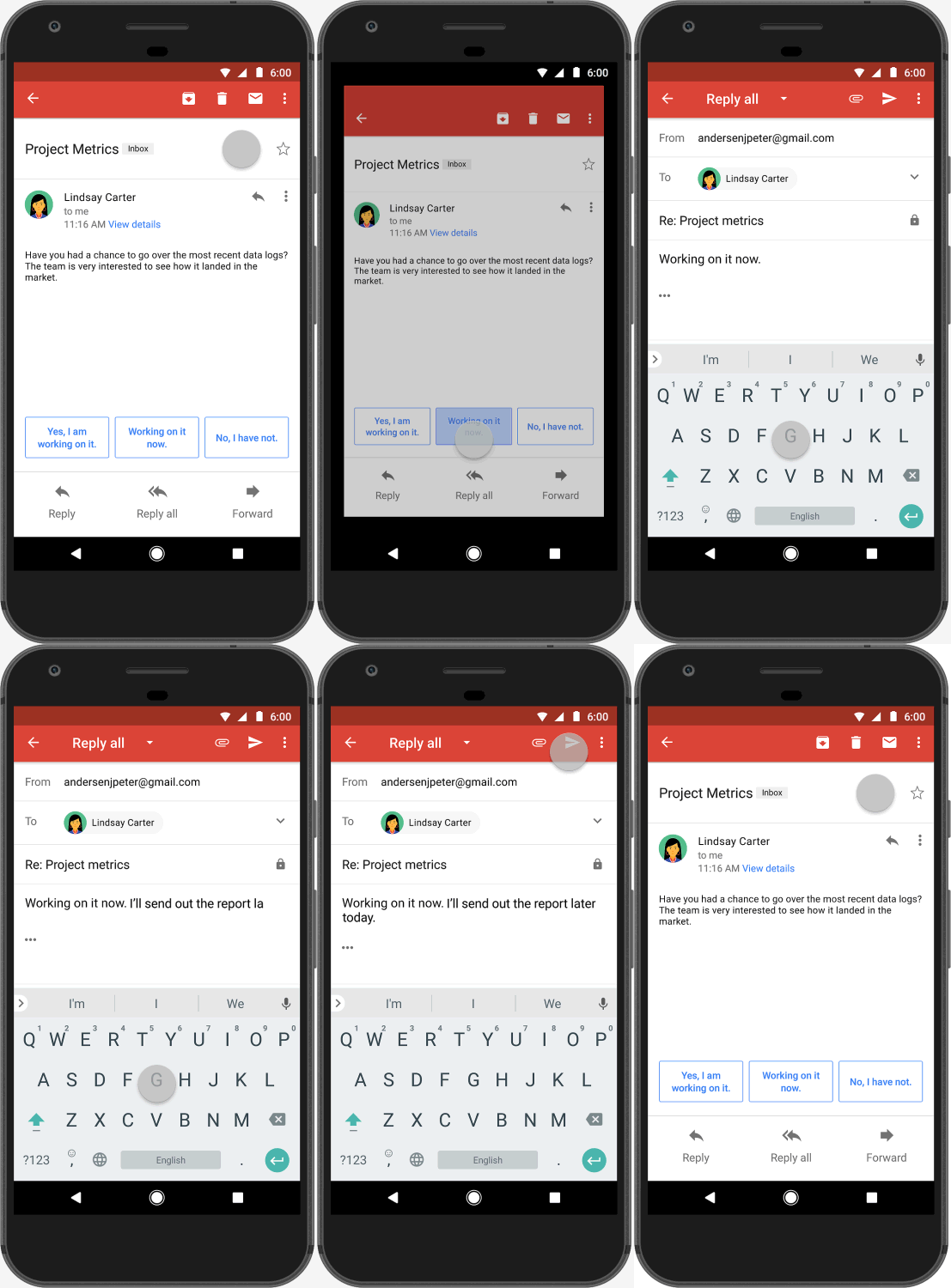
Google's Smart Reply feature, which suggests quick responses to your messages, that is already available on Inbox by Gmail and Google Allo is coming to Gmail.
The Smart Reply feature will suggest three short responses based on the email you received and then allows you select a response, and send it immediately with the smart reply text. You will also be able to edit the response before sending.
The main aim is to save time while replying to received messages, when you're on the go. The feature uses machine learning to offer you the best response as you start using it more often. So if you’re more of a “thanks!” than a “thanks.” person, Smart Reply will suggest the more suited response.
Smart Reply will roll out globally on Android and iOS in English first, and Spanish in the coming weeks, with other languages to follow.
Source
Google at its I/O 2017 event on Wednesday announced a new feature for Google Assistant called Google Lens, that will bring vision based computing capabilities to mobile devices to identify objects, and get more details.
Using Google Lens, you can point your smartphone camera at a subject to learn more things about it or take action based on that information. You can scan a flower to get more information about it or get username and password from WiFi network's SSID and connect to the internet, or identify a landmark, or restaurant an see ratings, reviews and other details.
For example "If you see a marquee for your favorite band, you can hold up your Assistant, tap the Lens icon and get information on the band, tickets and more."
Google Lens will be available first in Google Assistant and Photos, and will come to other products in the near future.
Google's voice controlled smart speaker, Google Home powered by Google Assistant is getting new features that will make it easier to get useful things done. These include schedule new calendar appointments, create reminder, make hands-free call and more.
New features coming to Google Home
- You can now schedule new calendar appointments with Google Home. It will also get the option to set reminders soon
- Make Hands-free calls to mobile phones or landlines in the U.S or Canada for free with Google Home. This feature will roll out in the coming months
- It will soon get Spotify's free music offering, as well as SoundCloud and Deezer
- Bluetooth support, so you can play any audio fron your iOS or Android device
- Besides Netflix you can now use your voice to launch videos from HBO NOW, CBS All Access and HGTV
- Get visual results from your Assistant on TVs with Chromecast. "You’ll be able to see Assistant answers on the biggest screen in your house, whether you're asking "what's on YouTube TV right now?" or "what's on my calendar today?"
Google also said that Google Home will be launching in more countries including Canada, Australia, France, Germany and Japan this summer without giving a specific date or availability.
Speaking of Google Assistant, it is also getting new features. Google announced that Google Assistant will soon let you type your question, instead of giving voice commands, making it easier to use Assistant in Public places where noise level is high. It will also get history within the conversation soon so that you can see what you’ve previously asked.
Google Assistant now will also be able to help you buy stuff or pay for services, without going to third party-site. Google has integrated its own payments processing system into Google Assistant. For instance, you can say Google Assistant to place order for a particular item or service, then select to pay from your saved wallet information, and use fingerprint to authenticate and complete the transaction.
Finally Google Assistant will also get support for additional languages including Brazilian Portuguese, French, German, Japanese soon, and by the end of the year, it will support Italian, Korean and Spanish.
Source | Via 1 | 2 | 3
Google launched the Daydream virtual reality platform at last year I/O 2016, allowing you to use compatible smartphone with Daydream supported headset for a immersive VR experience.
Now a year later at Google I/O 2017, the company announced that its Daydream VR platform will soon support standalone devices , which means you will won't require a smartphone to experience Daydream VR.
Google has teamed up with Qualcomm to create a standalone headset reference design powered by the Snapdragon 835 VR Platform. These headsets will be released By Google's partner companies later this year and will feature in-built WorldSense positional tracking, which is based on Tango-based tracking technology. This technology allows the headset to track your movements in space, without the need of having to install any external sensor.
Currently HTC and Lenovo are working on devices using Qualcomm's reference design and plans to launch standalone Daydream VR headsets later this year. At the moment there is no information of the price.
As mentioned earlier, standalone VR headsets doesn't require to be paired with a smartphone or PC, instead it come with built-in screen, processor, positional head-tracking along with sensor to function as a standalone device to deliver a high-quality VR experience. In simple words, all the core components are built into the headset.
Meanwhile, Google also announced that Samsung's Galaxy S8 and Galaxy S8+ will get Daydream support via a software update this summer. And LG's next flagship phone, most likely the V30, which will launch later this year will be Daydream-ready out of the box. These devices will join Google's Pixel phones, Moto Z, Huawei Mate 9 and ZTE Axon 7, among other handful of phones to support Daydream platform.
Source
Three years ago, Google introduced Android One, a program to bring affordable Android devices to emerging markets. But it failed to take off, given that Android One devices had to compete with other affordable phones, that were no part of the initiative.
Now Google is again attempting to bring budget Android platform for developing markets like India with a new experience called Android Go. It is somewhat similar to Android One, but Google is focusing more on the software, instead of hardware.
Android Go is a light-weight version of Android O platform designed to run on entry-level devices. It can run smoothly and efficiently on devices with lower spec phones featuring 1GB or less (512MB) RAM.
The Google apps that comes with Android Go are also optimized to use less RAM, storage space, and mobile data, including apps such as YouTube Go, Chrome, Gboard, Facebook Lite and more. The download size of these apps will be less than 10MB, and offers data saving features, lets you keep track of data consumed, support for regional languages, and offline viewing capabilities, which are tailor made for developing market.
Android Go will also have its own version of Play Store, where apps, that are specifically designed for entry-level devices are highlighted, while still giving users access to the entire app catalog.
The Android Go experience will ship in 2018 for all Android devices that have 1GB or less of memory.
Source
Google is bringing its artificial intelligence-driven, voice-controlled digital assistant, Google Assistant to iPhone to take on Siri. The announcement was made at Google's I/O 2017. It also said that Google Assistant is now being used in over 100 million Android devices globally.
While Apple already has Siri as personal assistant on its device, Google's Assistant might challenge it to some extent, giving iOS users an additional choice for digital assistant. However, since Google Assistant will not have native integration on iOS device, the performance will not be exactly similar to that on the Android devices. This is due to API restrictions. And since you can't remap the Home button from Siri to Google Assistant, you will have a add a widget to access it.
Due to these limitations it is unlikely that Google's Assistant will replace Siri, and Siri will remain the first digital assistant option for iPhone users.
Google Assistant is available as a separate app from the App Store. To use Google Assistant on iPhone, open the app and log-in to your Google account. Then tap on the center button to give the Assistant voice commands, like play music, ask for weather updates, set reminders and more.
Via
Google released Android O Developer Preview images back and in March for app developers and device makers. Now at Google I/O 2017, it announced the release of Android Beta for eligible Pixel and Nexus devices (Nexus 5X, 6P, and Player, as well as Pixel, Pixel XL, or Pixel C device).
This is the second preview of Android O, and is out as public beta, and includes few new features as well.
Registrations is now open for the upcoming Android O beta, and those who enrolled, will get OTA updates for Android O beta releases. This is same as the Android N Beta program. You can visit Android beta registration page to sign in using your email to enroll into Android O beta.
The features of Android O is categorized in two categories – Fluid Experiences and Vitals. The features in Fluid Experiences include notification channels, Picture-in-Picture mode, adaptive icons, improved keyboard navigation, along with new APIs inclduing autofill, font resources in XML, autosizing TextView, WebView enhancements and more. Whereas the Vitals experiences include better performance, security and battery optimization
Google also introduced new features like Play Protect, that can find issues in apps and protect your device from security threats; Smart Text Selection that improves copy and paste function using machine learning; and Notification Dots, a new way for developers to notify users about activity on the app.
Google's CEO Sundar Pichai also announced that the company has crossed two billion active Android devices milestone.
Source