Showing posts with label Google. Show all posts

Wednesday, 27 December 2017

Report: Google plans to open brick-and-mortar stores in India


According to a report from Economic Times, Google is planning to open brick-and-mortar stores to boost sales of its Pixel smartphones in India, the world's second largest smartphone market where the company is lagging behind competition, when compared to tech giants Samsung and Apple, as well as Chinese brands such as Xiaomi, vivo and Oppo.

The report further says that the company aims to launch these store in late 2018, along with experience center. The move comes after the positive response the company has seen at more than a dozen pop-up stores that it opened in malls in recent weeks across Mumbai and Delhi-NCR region.

Google has reportedly sent a request to two malls in the country seeking space to setup Google store. These stores is said to serve as experience centres, where consumers can get hands-on physical demo of the phone and get educated about its features, in addition to purchasing products. 

There are some features of the Pixel phones that can't be explained or demoed online. For instance, to explain the low-light photography function of Pixel 2 phones, Google had set-up a dark room in its pop-up stores. And this is one of the reason why Google is opting for offline stores.

Apart from the Pixel phone, Google is expected to sell other products like Home speaker, Chrome Cast, Daydream View headset, Chromebook and more in the store.

Friday, 22 December 2017

Price drop: Pixel 2, Pixel 2 XL starts at Rs. 49,999 and Rs. 67,999 respectively for a limited time


The Google Pixel 2 and Pixel 2 XL have their share of problems, but still are said to be one of the best flagship phones out there to experience the best of Android operating system.

The Pixel 2 and Pixel 2 XL were launched in India at a starting price of Rs. 61,000 and Rs. 73,000 respectively. The 128GB model of Pixel 2 and Pixel 2 XL were priced at Rs. 70,000 and Rs. 82,000 respectively.

And now just in time Christmas, Google has announced discount of up to Rs. 11,000 on these phones for a limited time.

On the occasion of the festive season the 64GB Pixel 2 will cost Rs. 49,999, while the 128GB model will set you back by 58,999. You can get a further Rs. 8,000 off on both models if you purchase the Pixel 2 using an HDFC credit card. It comes in Just Black, Clearly White and Kinda Blue color.

The Pixel 2 XL on the other hand will now cost Rs. 67,999 for the 64GB storage model, and Rs. 76,999 for the 128GB storage model. Here also the Rs. 8,000 additional discount is applied if you purchase the phone using an HDFC credit card. Color options are just Black and Black & White.

Flipkart is also having an exchange offer, under which you can trade in your old smartphone for the new Pixel 2 phone, and get up to Rs. 18,000 additional discount.

You can avail these offers online on Flipkart as well as offline stores across the country.

To recap the specs, the Pixel 2 has 5-inch Full HD 16:9 display and 2700mAh battery, whereas the Pixel 2 XL comes with 6-inch QHD+ pOLED 18:9 display and 3520mAh battery. Other specs are same and they include Snapdragon 835 processor, 4GB RAM, 12.2 MP dual-Pixel camera with OIS, 8MP front camera and fingerprint scanner.

They also come with special features like IP67 water and dust resistance; Active Edge function, which allows users to squeeze the phone's edge to launch Google Assistant (and trigger other actions as well); E-SIM slot; and pure Android 8.0 Oreo experience.

Monday, 18 December 2017

'Hey Google' hotword now available on more Android phones


For years we have been communicating with the Google Search or Assistant app using the voice Command "Ok Google". But when Google Home was announced, the search giant introduced a new phrase called "Hey Google" to interact with the speaker, in addition to the old phrase.

Back in October, Google started testing the new "Hey Google" hotword on a handful of Android smartphones. And now the hotword is getting a wider release, and is out on a number of Android smartphone.

A notification asking users to re-setup Google Voice is appearing on many devices such as Moto G5S/G5S Plus, Nexus 5X, OnePlus 5/5T to name a few. Tapping on the notifications starts the voice training process.

In case you have missed the notification, you can setup your voice by heading to Settings > Google > Search > Voice. And once the setup process is complete, you can use either "OK Google" or "Hey Google" to open Google Search and Assistant. Just like the old phrase, Hey Google also works when the screen is off on some devices.

Source

Google X will deploy light beam tech to connect rural India to the internet


X, the research arm of Google's parent company, Alphabet is working with Indian internet service provider AP State FiberNet to deliver internet service to millions of customers in the state of Andhra Pradesh, without cable.

Instead X is using Free Space Optical Communication (FSOC) links to deploy internet services, a solution that was used in Project Loon. For the unaware, X's Project Loon used hot air balloons to deliver internet access to remote areas in developing countries.

According to X, FSOC is just like "fiber optic cable, but without the cable" and uses light beams to deliver high speed, high capacity connectivity over long distance.  And because there’s no cable, this will save time, cost, and hassle involved in digging trenches or stringing cable along poles. The FSOC boxes can simply be placed on roofs or towers, and beam signal between the boxes across rivers, roads and railways. 

The FSOC links are said to provide connections of up to 20Gbps over long distances, which is enough bandwidth to connect major access points, like cell-towers and WiFi hotspots, that support thousands of people in rural and remote areas across the state, without spending much.

X says AP State Fibernet will roll out two thousand FSOC links to connect 12 million households and thousands of government organizations and businesses in Andhra Pradesh by 2019. 

Source

Saturday, 16 December 2017

Google Maps will now alert you when to get off the bus or train


Google Map has finally got a new transit feature that will notify you when to get off the bus. The feature was being tested few days ago, and is now live.

A notification will pop up on your lock screen reminding you to get off your bus or train as you get close to the destination. There's also a progress bar for bus/train that moves in real time for live updates. The feature will come in handy in case you fall asleep while traveling .


In addition, Maps will also offer step-by-step navigation, departure time, and ETA times for your next bus or train ride as well.  To use the new feature, open Google Maps, type your destination, select transit direction, and choose from your preferred route. Tap the “Start” button to get on your way.

The step-by-step directions in transit navigation come few days after Google added two-wheeler directions in the Maps for bikers. 

Source | Via

Google ends support for Tango to focus on ARCore


Google's Project Tango is an AR platform build specifically for smartphones. And now with the company's latest augmented reality platform ARCore is out and functional, Google has decided to shut down Tango on March 1, 2018.

Project Tango was first introduced in 2014 and was Google's first ever attempt on augmented reality. The technology enabled the smartphone to provide augmented reality experiences by understanding the world around it through 3D mapping.

However Tango enabled phones required extra expensive hardware like depth sensing camera, motion tracking camera and more to support the technology. The first Tango based device was the Lenovo Phab 2 Pro. One more device was released from Asus called ZenFone AR that utilized the technology and it was the last. Both were expensive and hardly picked up from the shelf. So the termination of the technology does not come as a surprise.

On the other hand Google will now focus on the new ARCore platform that brings AR experiences closer to Android users. It is a new developer toolkit, designed for building augmented reality apps for a broad range of devices, but does not require any specialized hardware. ARCore powers the recently released AR Sticker on the Pixel camera.

Meanwhile Google has released ARCore Developer Preview 2 with several technical improvements that are listed below.
  • A new C API for use with the Android NDK that complements our existing Java, Unity, and Unreal SDKs;
  • Functionality that lets AR apps pause and resume AR sessions, for example to let a user return to an AR app after taking a phone call;
  • Improved accuracy and runtime efficiency across our anchor, plane finding, and point cloud APIs.
Google also said that it will soon launch ARCore v1.0, with support for over 100 million devices. Also many augmented reality experiences will be available in the Play Store soon.

Source

Thursday, 14 December 2017

Google Assistant lands on tablet, Android Lollipop 5.0 phones


Google Assistant, the Pixel maker's AI powered voice-assistant was first launched in 2016, and was exclusively available on Pixel phones. However, earlier this year, the support rolled out for all smartphones running Android Marshmallow or later.

Now Google is rolling out Assistant for smartphones running Android 5.0 Lollipop. The support will roll out to users with the language set to English in the US, UK, India, Australia, Canada and Singapore, as well as in Spanish in the US, Mexico and Spain. It’s also rolling out to users in Italy, Japan, Germany, Brazil and Korea.

It looks like Google wants more users to use it voice assistant. If you've been following the Android Distribution stats, the latest report reveals that Lollipop is running on 26.3 percent of active devices out there, and is the second widely used Android mobile operating system. This is likely to be the reason for Google to extend Assistant support to Lollipop.

In addition Assistant will also support tablets as well, given that it runs Android Marshmallow or later version. It will be rolling out over the coming week to users with the language set to English in the U.S.

The Google Assistant is a beefed up version of 'OK Google' voice search/command. You can give voice commands to Assistant to set reminders, perform web search, ask for news or weather updates, control smart home products and more. To bring up Google Assistant, you can either long press the home button or say 'Ok Google' and give the voice commands.

Apart from smartphones and tablets, Google assistant is also available on Android Wear 2.0 watches, Google Allo Chat app and smart speakers. 

Source

Tuesday, 12 December 2017

Now you can switch to Duo video call right in the middle of an ongoing phone call


Google has added a new feature on its Phone app that will allow you to start a Duo video call in the middle of an ongoing voice call. The feature was first spotted on Pixel 2 back in October, but is now available for all devices, given that you use the Google Phone and Duo app.

If you are using Google Phone app, and you call someone who has Duo installed on their device, a new video call button will appear in the Phone's app in-call list of options. 

Hitting this button will end the ongoing voice call on both ends and launch the Duo app with the caller's camera being automatically active with the Knock-Knock feature. The recipient can choose to accept or decline the video call. However, there is no special tone to indicate the caller is starting a video call, so the recipient need to be watching the screen or will miss the invite.

If the recipient accepts the video call, the original phone call will automatically end and launch the Duo app. In case the recipient declines the video call, it will eventually time out and return to the phone's in-call screen. Do note that, the Duo app won't switch to a video call if the recipient doesn't unlock their device. If the the phone is locked, the recipient will get a  message that says the device must be unlocked to start the video call. The caller will get a message stating that the other person is unavailable.

A call switched to video chat on Duo will appear two times in your calls longs, one from the original phone call and other for the Duo video call.

Source | Via

Google's AR Stickers now available for Pixel phones


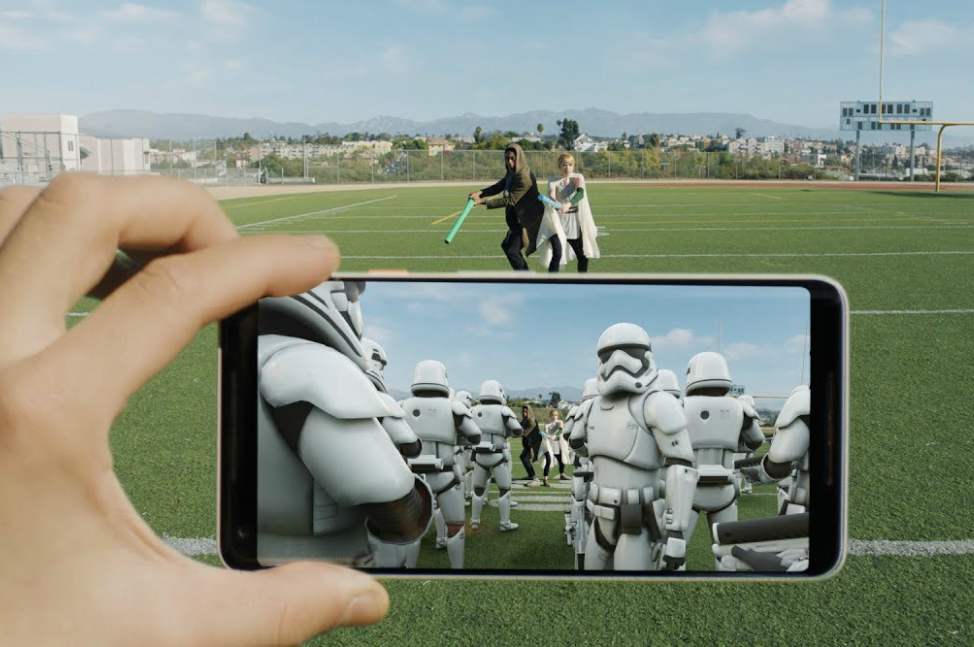
Google has finally released AR (augmented reality) stickers for its Pixel phones. To remind  you, the feature was previewed during the unveiling of Pixel 2 phones, but now it is rolling out to all Pixel users, given that the phone runs Android 8.1. Also you'll have to update  both ARCore and AR Stickers apps on your phone. The links to the apps are provided at the end of this post.

The AR stickers uses ARCore augmented reality platform, and allows you to add virtual character or playful emojis into your photos and videos using the camera app, to bring your favorite stories to life.  

To use AR stickers, open the camera app on your Pixel phone, slideout the side menu to access modes and switch to AR Stickers mode. Then choose a sticker pack and drop them into the scene. Currently, the AR stickers include characters and content from Stranger Things and Star Wars, as well as Foodmoji stickers, that include animated donuts, coffee cups and brocolli, but Google promises to add more sticker packs in the future.

After adding the sticker, you can then move, resize and rotate than, and interact with other characters in the scene. Once you capture a picture or video you can quickly and easily share with friends on social media as well.

Download: ARCore | AR Stickers | Source


Google outs three new mobile photography apps

Google has announced appseriments program, and as part for the first installment it has launched three new photography apps for Android and iOS devices: Storyboard, Selfissomo! and Scrubbies.

According to Google the 'appsperimental' approach was inspired by an app called Motion Stills, that convert short videos into cinemagraphs and time lapse using experimental stabilization and rendering technologies. It further mentioned that the new appsperiments app rely on object recognition, person segmentation, stabilization algorithms, efficient image encoding and decoding technologies to offer a fun way to snap photos.


Speaking of the newly launched apps, starting with Storyboard, the app transforms your videos into single-page comic layouts, entirely on device. Just shoot a video and load it in Storyboard, and the app will automatically select interesting video frames, lay them out, and applies any one of the six visual styles. Then you can choose tosave the comic, or pull down and instantly produce a new one. According to Google, there are approximately 1.6 trillion different possibilities to discover. Storyboard is only available for Android. [Download]


Next is Selfissimo!, and has the name suggests the app is designed for selfie lovers. It is an automated selfie photographer that snaps a stylish black and white photo each time you pose. You can start the photo shoot by tapping the screen, and the app encourages you to pose and capture photo whenever you stop moving. To end the selfie session tap the screen and the images will appear on the contact sheet for reviewing. You can then choose either to save indiviual images, or the entire shoot. Selfissimo is available for both Android and iOS. [Android | iOS]


Lastly, Scrubbies, the app will be available only for iOS devices and lets you easily manipulate the speed and direction of video playback to produce video loops that highlight actions. You can also capture funny faces and replay moments.  To use the app, just shoot a video and then remix it by scratching it like a DJ. Scrubbing with one finger plays the video. Scrubbing with two fingers captures the playback so you can save or share it. [Downlaod] 

Source

Android 8.0 Oreo adoption rate hits 0.5%, Nougat now on 23.3%


Google is out with the Android distribution numbers for December and as per the latest data, Android Oreo jumped up slightly to 0.5 percent, an increase of mere 0.2 percent than 0.3 percent in November.

The latest number is not mind-boggling, but given that there are more than billion of Android devices out there and official Oreo started rolling out two months ago, the increase is significant. For comparison sake, during the same period last year, when Nougat was the latest iteration of Android, it was only present in 0.4 percent of active devices.

Speaking of the other Android versions, Nougat adoption rate climbed from 20.6 percent in November to 23.3 percent in December, an increase of 2.7 percent, while Marshmallow's lost 1.2 percent share of the pie, and is now present on 29.7 percent of active Android devices as compared to November's 30.9 percent. Marshmallow is the still the most widely adapted version of Android.

Android Lollipop adoption in November was 27.7 percent, but as per December's stats it lost 1.4 percent of the pie, and is now running on 26.3 percent devices.

As for the outdated operating system, KitKat is now present on 13.4 percent devices (13.8 percent in November), Jelly Bean on 5.9 percent (6.2 percent in November), and lastly, Ice Cream Sandwhich and Gingerbread stand at 0.5 percent and 0.4 percent respectively.

The Android Distribution numbers are gathered from devices running Android 2.2 accessed the Play Store in a seven-day period ending on December 11, 2017. It's worth mentioning that devices running older Android version like Honeycomb and Froyo are not included. Also devices that don't have Google Play installed like Android phone and tablets in China, are not taken into account as well.   

Source

Monday, 11 December 2017

Google Chrome for Android will soon get custom download folders


Google's Chrome browser for desktop, lets you select the folder to store the file you download from the web. However, this feature is not available on the Android version of Chrome.

Currently, when you download a file on Chrome for Android, it is stored on the phones default storage. To be more precise the downloaded files are stored on /Downloads folders in /data/media/user, and you cannot change this path. The folder can get cluttered since various file types like music, archives, documents, photos and more are downloaded to the same location.

Further in case you have low storage on your device or own an entry level phone with 4GB or 8GB storage which fills up fast, downloading large files will be a headache, and you may want to change Chrome's download folder to the device's SD card.

That is going to happen soon as Chrome browser for Android is said to get a new feature that will let you change the default download folder. This means you'll be able to change the default download location to any folder on the phones native storage or download the files to the the microSD card. 

A commit was discovered in the Chromium gerrit (web-based team code collaboration tool for Chrome) which hints at the arrival of this  new feature. However it is still work-in-progress, and will take some time to arrive on the beta and stable channel of Chrome. 

Source

Deal: Pixel 2 XL receives Rs. 8000 limited time price cut in India


Google's latest and greatest Pixel 2 XL was launched in India in October this year, starting at Rs. 73,000 for the 64GB storage model, and Rs. 82,000 for the 128GB storage model. However, now the phone's both variants have reportedly got a price cut.

According to Mumbai based retailer Mahesh Telecom, the Pixel 2 XL 64GB and 128GB storage models price has been dropped by Rs. 8,000 for a limited time are now up for grabs at Rs. 64,999 and Rs. 73,999 respectively. The offer is valid from December 9 to 31, and there's also an additional cash back of Rs. 8,000 on HDFC credit card EMI transaction.

To recollect the specifications, the Pixel 2 XL features 6-inch QHD+ pOLED 18:9 display, Snapdragon 835 processor, 4GB RAM, 12.2 MP dual-Pixel camera with OIS, 8MP front camera, 3520mAh battery and fingerprint scanner.

Other notable features are IP67 water and dust resistance; Active Edge function, which allows users to squeeze the phone to launch Google Assistant; USB Type-C port; NFC; Bluetooth 5.0; E-SIM slot; and pure Android 8.0 Oreo experience. Sadly there's no 3.5mm audio jack on these phones, so you will have to use USB Type-C enabled audio headphones.

Google Maps' real-time notifications, live guidance coming soon to transit mode


Google is reportedly planning to add a new feature to Google Maps that will give you live guidance and interactive real-time notifications while your are on your transit journey. It will also tell you when to get off the bus or train.

According to TechCrunch, the new feature will be rolled out soon, and the publication also shared a screenshot of how the new feature will look like. This feature works the same as driving mode.

For starters, you have to search for your transit directions in the Maps app just like you do for driving mode. However, now you'll see a 'start' button at the bottom on the screen, and tapping on it will give you details about the transit journey, and offer live updates as you ride on local buses and trains. 


Further you will also get notifications on the Android lock screen as well, just like it does while driving. You can also scroll up to make sure you are going the right way during the journey. Lastly the  feature will remind you to get off your bus or train when you get close to the destination. 

Google Maps upcoming feature will come in handy if you are traveling to a new city, state or country via transit system or in case you fall asleep while traveling. Previously to get an update on the transit journey, you had to go back the Maps app and keep track of your own progress along the route, but with the new feature, you'll get notifications as you reach your journey, just like walking, biking and driving. This means now you don't have to keep your eyes on the Maps app to get the update.

In the last update, Google enabled Two-wheeler mode on Maps to offer riders with better navigation and directions that are best suited for them to reach the destination.

Sunday, 10 December 2017

Google outs list of Android Wear watches that will get Oreo update


Google rolled out Android Wear 8.0 Oreo to select watches starting with the LG Watch Sport and other models a few days ago

The improvements in the latest version of Android Wear include customizable vibration patterns for notifications, Touch Lock feature to prevent touch screen inputs, Support for seven additional countries/languages, more notification channels and new background limits for improved battery life.

Now Google has released the complete list of watches that will get the new update. The company has not revealed when these watches will get the latest update, so you'll have to contact the device manufacturer for the exact timing. 

Android Wear Oreo(8.0) update is already available in the following watches:
Fossil Q Venture
LG Watch Sport
Louis Vuitton Tambour
Michael Kors Sofie
Montblanc Summit 


Watches that are currently pursuing the Android Wear Oreo (8.0) update:
Casio PRO TREK Smart WSD-F20
Casio WSD-F10 Smart Outdoor Watch
Diesel Full Guard
Emporio Armani Connected
Fossil Q Control
Fossil Q Explorist
Fossil Q Founder 2.0
Fossil Q Marshal
Fossil Q Wander
Gc Connect
Guess Connect
Huawei Watch 2
Hugo BOSS BOSS Touch
LG Watch Style
Michael Kors Access Bradshaw
Michael Kors Access Dylan
Michael Kors Access Grayson
Misfit Vapor
Mobvoi Ticwatch S & E
Movado Connect
Nixon Mission
Polar M600
TAG Heuer Tag Connected Modular 45
Tommy Hilfiger 24/7 You
ZTE Quartz


The Android Wear watches dropped from the support include Asus's ZenWatch 2/3, original Fossil Q Founder, LG GWatch R/Urbane/Urbane LTE, Moto 360 second gen/360 Sport and the orginal Huawei Watch. The Android version of these watches will remain at Nougat, but they will continue to receive Android Wear update via the Play Store. 

Source | Via

Saturday, 9 December 2017

Google re-enables touch control on Home Mini


The Google Home Mini is a $49 smart speaker, and is one of the most affordable smart speaker to support Google Assistant. However soon after its release, Google had to disable the touch sensor, as the speaker triggered on its own and started recording at random occasions due to the improper calibration of the touch sensor. 

Google was quick to address the issue and disabled the top touch activation feature  of Home units completely due to privacy concerns, preventing the speaker from accidentally recording everything. The single tap functions, which would start and pause music, snooze alarms and end phone calls were disabled as well.

Having said that, Google is bringing back some of the touch functionality with the addition of side press. But now instead of tapping the top of Google Home Mini, you will have to long-press the left or right side to play/pause music, end phone calls, silence alarms without giving voice commands to the device. Previously, you could only control the volume of the speaker by tapping on the side.

This will come as a firmware update with v1.29, which will roll out today. The update will start in the preview firmware channel. You can join the channel from the Home app settings. 

Source | Via

Friday, 8 December 2017

YouTube reportedly launching new paid music streaming service in March 2018


According to a report from Bloomberg, Google is working on a new paid music subscription service to compete with rivals like Apple and Spotify The search-giant is planning to launch the service by March 2018.

The new music subscription service is internally referred as Remix, and is said to be different from other two rivals. Google is planning to bring on-demand streaming along with incorporating elements such as video clips from YouTube. It has also reached out to artists to seek their help promoting the new service.

The report further mentions that YouTube has already signed a deal with Warner Music Group one of world’s three major record labels, while talks are underway with Sony Music Entertainment and Universal Music Group.

This will be Google's third attempt to compete with other music streaming services. In 2011, Google introduced Play Music, followed by YouTube Music Key in 2014, giving subscribers add-free music video. Then in 2016 it released YouTube Red, enabling users to watch any video without advertising. However, Google did not have the same success as Apple or Spotify in convincing people to sign for its paid services.

Having said that, paid services from Spotify and Apple Music are growing again after almost two decades of decline. So it appears that, YouTube is giving this market another try.

Thursday, 7 December 2017

Android Wear is getting Android Oreo


Over two months after releasing the Android Oreo based Android Wear beta, Google has finally started rolling out the official Oreo update to supported Android Wear wearables.

The announcement was made by Hoi Lam, Wearable Developer Advocate at Google. Lam said the update is being released today and the timing of the update is determined by each Android Wear smartwatch's manufacturer. According to Android Police, the LG Watch Sport is already receiving the update.

Even though this is an OS upgrade, it doesn't bring any major changes and includes a handful of new features. These are customizable vibration patterns for notifications, Touch Lock feature to prevent touch screen inputs, Support for seven additional countries/languages, more notification channels and new background limits for improved battery life.

Via

Wednesday, 6 December 2017

Google rolls out Android 8.1 for Pixel and Nexus devices


After two developer previews, Google has finally released the final Android 8.1 Oreo update along with December Android security patch for compatible Pixel and Nexus devices.

Android 8.1 is a minor maintenance release after the major Android Oreo update and includes Neural Networks API that allows the Pixel 2 phone to take advantage of the Pixel Visual Core SoC. It enhances Google's photo apps to run faster, and will enable third party photography apps to take HDR+ quality images. 

Other features Android 8.1 includes are listed below
  • Support for Android Oreo (Go edition) software for entry-level smartphones with less than 1GB RAM
  • Neural Networks API: Enables hardware-accelerated inference operation on support devices for on-device machine learning frameworks lie TensorFlow, Caffe 2 and others
  • Autofill enhancements:  Password managers and other Autofill service can use Autofill framework
  • SharedMemory API
  • Screen burn-in mitigation
  • Emoji fixes: new hamburger, cheese & beer emoji
  • December Android security patch
Android 8.1 Oreo is now being rolled out to Pixel 2, Pixel 2 XL, Pixel, Pixel XL, Pixel C tablet, Nexus 5X and Nexus 6P. You can grab the update over-the-air or through flashing the OTA or full factory images. 

Tuesday, 5 December 2017

Flipkart's Big Shopping Days: Pixel 2 to be available at Rs. 39,999


Flipkart is all set to kick off its Big Shopping Days sale which starts December 7 and will run till December 9. In time for the sale, Google has announced discount on its latest Pixel 2 phone, which will be up for grabs for as low as Rs. 39,999 during the sale period.

The Pixel 2 64GB model has a retail price of Rs. 61,000, but during the Shopping days sale, Google is offering flat discount of Rs. 11,001, which will bring the price down to Rs. 49,999. In addition credit or debit card users will get further Rs. 10,000 discount off on the phone, bringing the effective price of Pixel 2 64GB down to Rs. 39,999. This bring the price of the Pixel 2, the best Android phone on par with flagship killer OnePlus 5T.

Flipkart is alo running an exchange offer, under which you can get up to Rs. 18,000 off on Pixel 2, if you exchange your old handset. Also customers will be offered buyback guarantee of Rs. 36,500 on the Pixel 2 if you choose to exchange the for a new one in 6 to 8 months.


To recap the specs, the Pixel 2 comes with 5-inch Full HD display, Snapdragon 835 processor, 4GB RAM, 12.2MP dual-Pixel camera with OIS, 8MP front camera and 2700mAh battery.

Other notable features are fingerprint scanner, IP67 water and dust resistance; Active Edge function, which allows users to squeeze the phone to launch Google Assistant; USB Type-C port; NFC; Bluetooth 5.0; E-SIM slot; and pure Android 8.0 Oreo experience. Sadly there's no 3.5mm audio jack on these phones, you will have to use USB Type-C enabled audio headphones.